The two civil society organisations, Reactor – Research in Action and the National Council for Gender Equality, monitored the 2025 Local Elections, with a focus on gender equality and women’s participation. These activities were carried out within their sub-grants awarded under “EU Support to the Citizens’ Resource Center – Phase 2”. The findings of the two organisations are based on different methodological approaches and cover different phases of the electoral process, but point to serious and long-term challenges related to gender equality.
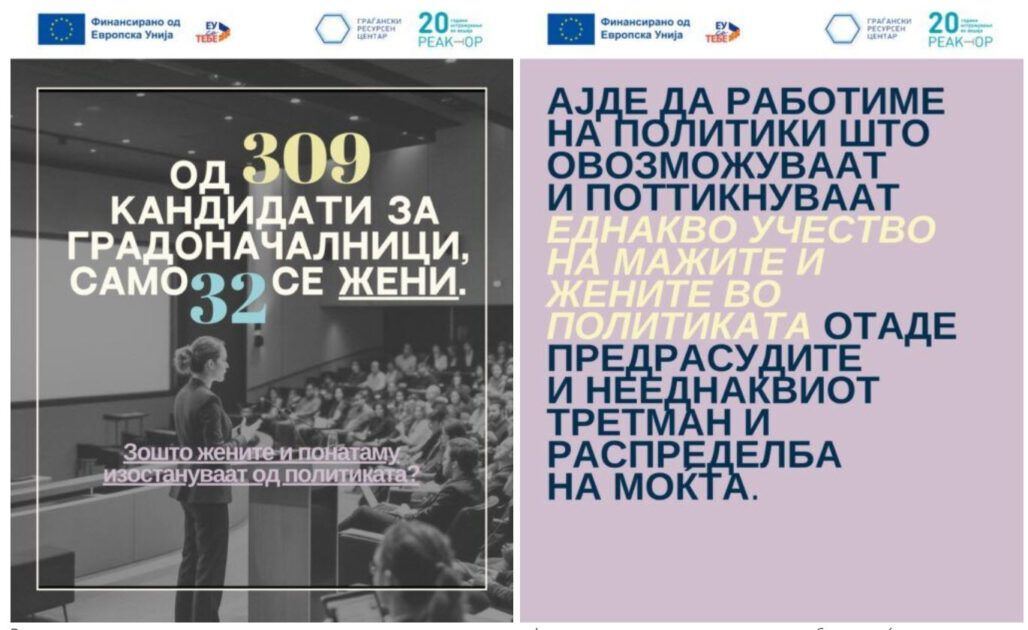
The monitoring conducted by the association Reactor – Research in Action shows that, despite a slight increase in the number of women candidates, substantial progress in women’s political participation has not been achieved. According to the findings in their publication “Local Elections 2025 – A Review of Candidate Lists for Mayors and Elected Incumbents from a Gender Perspective”, in the 2025 local elections, out of a total of 309 candidates for mayor, only 32 were women (around 10%), and only 4 women won the mayoral position (around 5% of the total number of municipalities). These data indicate that the most pronounced gender inequality continues to exist in executive positions.
In terms of municipal councils, although the quota system allows for a greater formal presence of women, the distribution of power remains uneven. Out of a total of 4,737 female candidates, 466 women won council mandates, compared to 841 elected male councilors. The exception is the Municipality of Veles, where a female majority is registered in the Council (14 female councilors versus 9 male councilors), which Reactor identifies as a result of specific local circumstances, rather than systemic changes. The analysis further shows that local policies related to safety, care services and accessibility, although often indicated by women as priorities, are rarely treated as central topics in the election programs.
The National Council for Gender Equality (NCGE) conducted gender-sensitive election day observation in 12 municipalities, through 20 trained and accredited observers, who monitored 12 polling stations. The findings show that the election process was largely peaceful and without serious incidents, with a visible presence of women both as voters and as members of the election boards.
Field data indicate variations in female turnout. For example, in some polling stations, women made up around 48–49% of voters, while in other areas the turnout was around 36–37%, indicating the influence of local, social and cultural factors. The NSRR also recorded 6 to 8 cases of family voting or direct influence on women’s choices, with the reaction of the election boards being uneven – from appropriate intervention to complete absence.
Additionally, physical barriers to polling stations, such as stairs and narrow rooms, were observed in some of the monitored municipalities, which particularly affect older women, pregnant women and women with reduced mobility. At the same time, female leadership in election boards was identified as a positive factor contributing to better organisation and greater protection of the privacy of voting.
The findings of both organisations indicate that, although the 2025 Local Elections were formally conducted in accordance with the legal framework, gender equality remains limited and uneven. Reactor points to a serious gap between the formal representation and the real political power of women, while NCGE indicates that the quality of gender-sensitive practice on the ground varies significantly between municipalities. The common conclusion of the organisations is that systemic and long-term measures are needed to promote a gender-equal and inclusive electoral process at the local level.
The activities are part of “Local Voices for Democracy: Power, Influence and Equality in Practice” implemented by Reactor – Research in Action and “My Future, My Choice – Empowered Women and Girls for Transparent and Inclusive Local Elections 2025” implemented by Union – National Council for Gender Equality. These two projects are sub-grants awarded under the project“EU Support for Citizen Resource Center – Phase 2” funded by the European Union.